

What Is a Photography Contingency Plan for Events?
A photographer’s contingency plan for events is a documented set of backup procedures covering four pillars: equipment redundancy, personnel substitution, insurance and COI coverage, and data protection workflows. Every professional photographer you hire should have all four in place before your event day.
Here is what that looks like in practice:
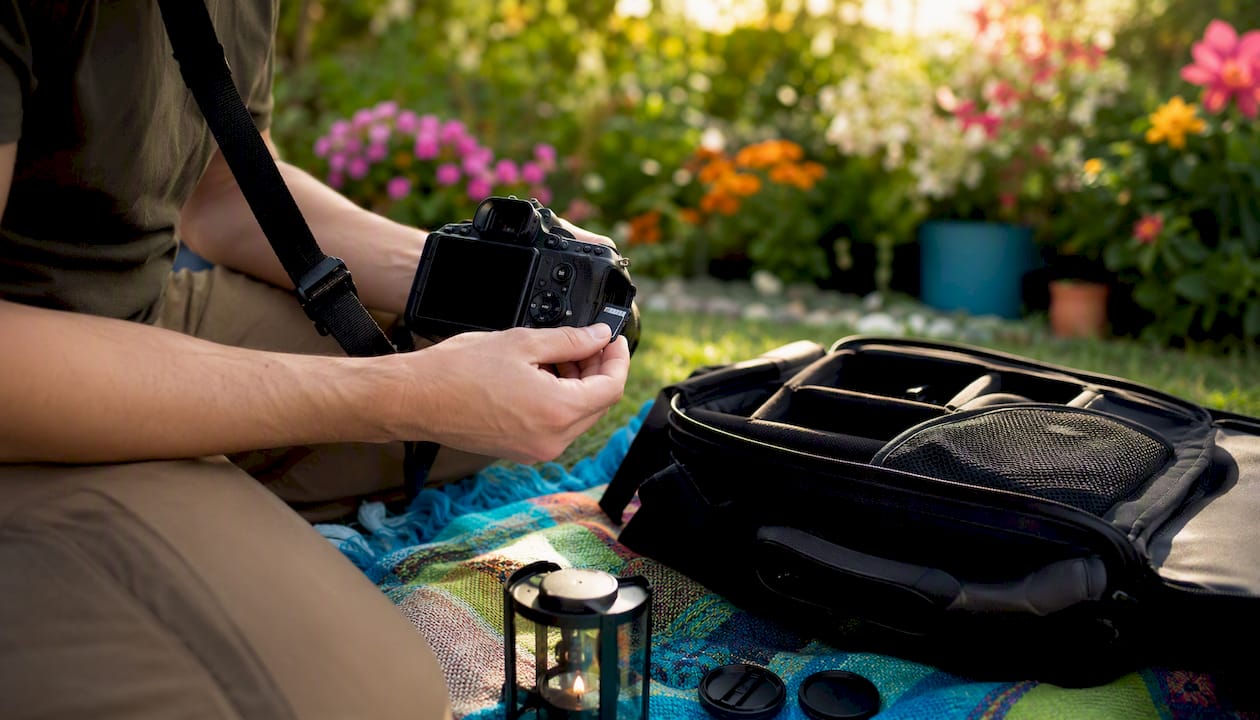
- Equipment: Two camera bodies on the photographer’s person, a third in the car, spare batteries, flash units, and pre-paired triggers
- Personnel: A named second shooter or substitute photographer, with their own liability insurance, ready to step in
- Insurance: A Certificate of Insurance (COI) naming your venue as Additional Insured, with at least $1M per occurrence / $2M aggregate General Liability
- Data: Dual-card mirror-write during the shoot, on-site offload to a laptop SSD at natural breaks, and an off-site or cloud copy by the following morning
Ask your photographer for these in writing. If any item is missing from their contract, request it before signing.
Key Takeaways
A photographer’s contingency plan for events is only as reliable as the written commitments behind it: gear, personnel, insurance, and data protection must all be documented in your contract before the event day.
| Point | Details |
|---|---|
| Four-pillar plan | Every photographer should cover equipment redundancy, personnel substitution, COI insurance, and 3-2-1 data backups. |
| COI requirement | Venues typically require $1M per occurrence / $2M aggregate GL, with your venue named as Additional Insured. |
| Mirror-write data protection | Dual-card mirror-write plus an overnight cloud copy follows the 3-2-1 rule and prevents single-point image loss. |
| Contract over verbal promises | Substitution thresholds, reshoot policies, and liability caps belong in a signed contract, not a conversation. |
| JFPhotos | JFPhotos provides a written contingency addendum, COI issuance within 24 hours, and a backup shooter network for every booked event. |
Table of Contents
- What a photographer’s contingency plan covers
- How professional photographers stage gear redundancy
- Backup personnel: second shooters and substitutes
- Insurance basics every client should verify
- How image backup and the 3-2-1 rule protect your photos
- Common failure scenarios and what your photographer should commit to
- Exactly what to ask your photographer before signing
- Typical costs and who pays for contingency measures include insurance premiums, COI issuance fees, second shooter fees, spare gear rental, and substitute travel costs. Responsibility varies by item and situation.
- Sample contingency clause and a day-of checklist to request
- How JFPhotos handles contingency planning for weddings and events
- Why contingency planning protects both sides
- Book your event with JFPhotos
- Sources
What a photographer’s contingency plan covers
A complete event photography backup plan addresses six categories. Here is what each one means for you as a client:
- Equipment redundancy: Multiple camera bodies, lenses, flash units, and batteries so a single failure never stops coverage
- Personnel substitution: A clear policy for who steps in if the primary photographer is ill, injured, or delayed, and how quickly that substitute is activated
- Insurance and COI: Proof of General Liability and Errors & Omissions (E&O) coverage, with your venue named as Additional Insured before the event
- Data and delivery workflow: A written process for backing up images during and after the event, including what happens if a card corrupts
- Weather and location alternatives: At least three confirmed indoor or covered locations, with a decision timeline agreed in advance
- Communication protocol: How and when you are notified if a contingency is activated, and who your point of contact is throughout the day
Pro Tip: Ask your photographer to confirm the weather decision timeline in writing. Industry practice places that window at 48–72 hours before the event, giving all vendors enough time to coordinate the change.
How professional photographers stage gear redundancy
The Professional Photographers of America describes a three-tier redundancy hierarchy that clients should expect from any professional:
- Tier 1 — Active bodies on person: Two camera bodies worn or carried during the shoot, each loaded and ready
- Tier 2 — Secondary backup on person or nearby: A third body in a bag at the photographer’s feet or at the second shooter’s station
- Tier 3 — Car spare: A fully charged backup body in a locked vehicle at the venue, retrievable within minutes
Beyond bodies, a complete event photography gear kit includes spare batteries for every body, a second flash with a pre-paired trigger, and extra memory cards. For outdoor or wet-weather events, weather-sealed bodies and rain covers belong in the bag.
The day-of workflow matters as much as the hardware. According to Tov Studio Photo’s practitioner guide, a reliable workflow writes to both card slots simultaneously (mirror-write mode), offloads to a laptop SSD during natural breaks like cocktail hour or dinner, and keeps a secondary external drive as a second on-site copy.
Pro Tip: When interviewing a photographer, ask specifically whether they shoot in mirror-write mode or relay mode. Mirror-write saves every frame to two independent cards at once; relay only switches to the second card when the first is full, leaving earlier frames on a single card.
Backup personnel: second shooters and substitutes
A second shooter and a substitute photographer are not the same thing. A second shooter is a co-photographer booked for your event, present from the start, capturing different angles alongside the primary. A substitute is the person who steps in if the primary photographer cannot attend at all.
Your contract should name both scenarios explicitly. For second shooters, the key question is whether they carry their own liability policy. Many venues and corporate clients require each contracted photographer to provide an individual COI, so confirming this before the event prevents last-minute access issues.
For substitution, request language like this in your contract:
Insurance basics every client should verify
Most venues require a COI naming them as Additional Insured, with $1M per occurrence and $2M aggregate General Liability, before allowing a photographer on-site. Many venues also accept same-day COI issuance through specialty-carrier portals, so a last-minute request is often solvable if the photographer works with the right program.
When you receive a COI, verify these four items:
- Policy dates cover your event date
- Named insured matches the photographer’s legal business name
- Additional Insured lists your venue by its exact legal name
- Cancellation notice clause gives you at least 30 days’ written notice of any policy change
How image backup and the 3-2-1 rule protect your photos
The 3-2-1 backup rule is the industry standard for image protection: at least 3 copies of every image, on 2 different media types , with 1 copy stored off-site . For event photography, that translates to a specific daily workflow:
- Copy 1: Images on the camera’s primary card (in-camera)
- Copy 2: Mirror-write duplicate on the second card slot, offloaded to a laptop SSD at breaks
- Copy 3: Cloud or external off-site upload completed by the morning after the event
One common mistake photographers make is relying on folder sync instead of a versioned backup. Syncing can replicate deletions and corrupted files across all connected devices, wiping out what looks like a safe copy. Versioned backups let you roll back to a prior good state, which is the only reliable recovery path after card corruption.
Pro Tip: Ask your photographer which cloud service they use and whether it supports versioning. Services that offer version history (rather than simple sync) give you a meaningful recovery option if something corrupts post-shoot.
| Backup Layer | Media Type | Location | Timing |
|---|---|---|---|
| In-camera mirror-write | Dual memory cards | On person | Continuous during shoot |
| Laptop SSD offload | Internal SSD | On-site | At natural breaks |
| Cloud / off-site copy | Cloud storage | Off-site | Overnight after event |
Common failure scenarios and what your photographer should commit to
| Failure Scenario | Primary Response | Fallback Action | Client Notification |
|---|---|---|---|
| Camera body failure | Swap to backup body on person | Retrieve car spare within minutes | None needed if seamless |
| Card corruption | Use mirror-write duplicate | Restore from SSD offload copy | Within 24 hours if any loss |
| Photographer illness / no-show | Activate named substitute | Contact mutual-aid network | Within 2 hours of decision |
| Severe weather | Move to pre-confirmed indoor location | Reschedule outdoor portion | 48–72 hours before event |
| Travel delay | Notify client immediately; second shooter leads | Substitute dispatched if delay exceeds 60 min | Real-time by phone or text |
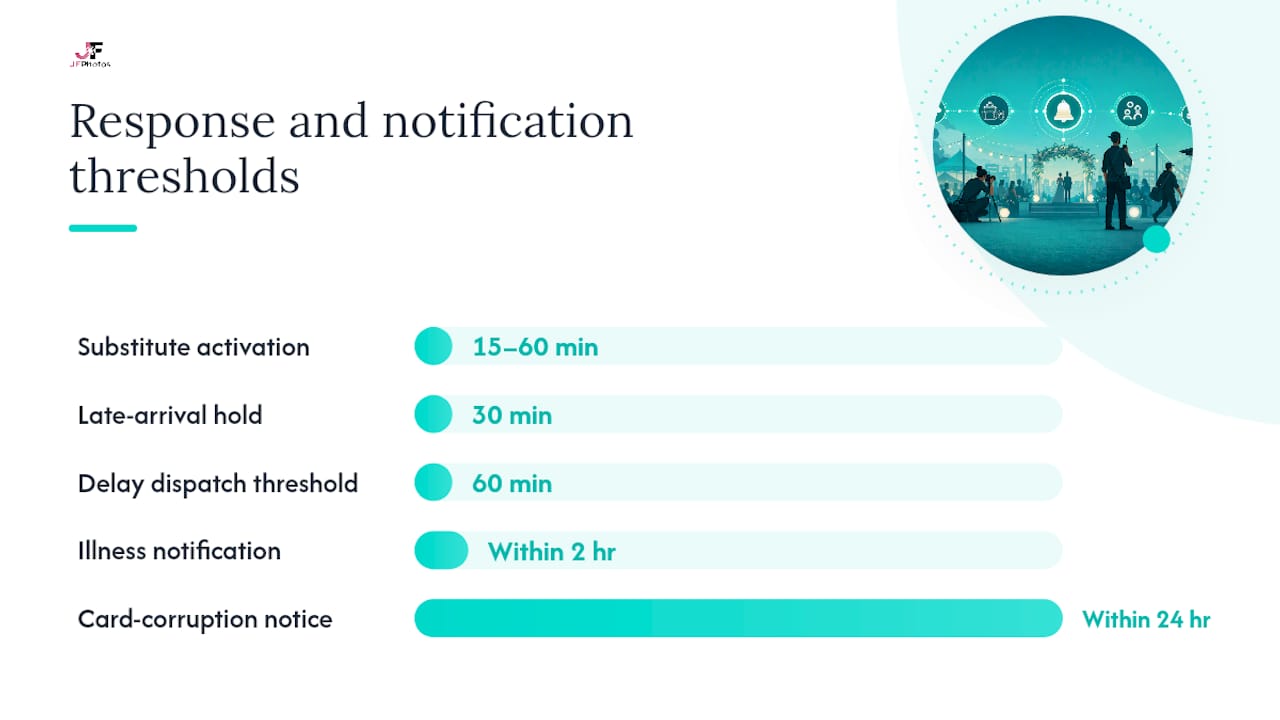
Substitution is typically activated within 15–60 minutes depending on the situation. A no-show triggers immediate substitute dispatch; a late arrival triggers a 30-minute hold before escalating. Your contract should specify both thresholds.
Standard remediation commitments to request in writing:
- A reshoot policy for events where coverage was materially incomplete
- A partial refund schedule tied to specific coverage failures
- A limitation-of-liability cap (typically the contract value) for circumstances beyond the photographer’s control
Exactly what to ask your photographer before signing
Use this checklist during your consultation. Each question has a short, copyable phrase you can paste into an email or bring to a meeting.
- Gear redundancy: “How many camera bodies will you have on your person during the event, and where is your tertiary backup?”
- Substitute policy: “Who is your named substitute, and what is their minimum insurance coverage?”
- COI: “Do you carry a COI naming [venue name] as Additional Insured for $1M/$2M General Liability?”
- Data workflow: “Do you shoot in mirror-write mode, and when do you complete your first off-site backup?”
- Delivery after a disaster: “What is your delivery timeline if a card fails or data recovery is required?”
Red flags to watch for: vague answers like “we’ll handle it if something comes up,” no written substitution policy, or a photographer who cannot produce a sample COI within 24 hours of your request. These are signs that contingency planning is not part of their standard process.
For a broader corporate event photo checklist, including vendor coordination and coverage expectations, JFPhotos has a planner-specific resource worth reviewing.
Typical costs and who pays for contingency measures include insurance premiums, COI issuance fees, second shooter fees, spare gear rental, and substitute travel costs. Responsibility varies by item and situation.
Standard redundancy gear and annual insurance are the photographer’s cost to operate professionally. Second shooters are typically an add-on you select at booking. Where costs shift to you is in destination or urgent-replacement scenarios.
Pro Tip: If your event requires a substitute to travel more than two hours, clarify in the contract whether travel costs are capped or reimbursed separately. Leaving this open creates disputes after the fact.
Sample contingency clause and a day-of checklist to request
Ask your photographer to include language like the following in your contract. This is an example clause, not legal advice. Have a lawyer review any limitation-of-liability language before signing.
Printable day-of checklist to request your photographer initial:
- COI delivered to venue at least 48 hours before the event
- Two camera bodies confirmed on person at start of coverage
- Mirror-write mode enabled and verified before ceremony begins
- First SSD offload completed by end of cocktail hour or equivalent break
- Substitute photographer contact information shared with client
- Weather decision confirmed in writing 48–72 hours before outdoor coverage
A solid wedding photography contract documents coverage hours, deliverables, cancellation terms, and limitation-of-liability language. Every contingency commitment belongs in that same document, not in a verbal promise.
How JFPhotos handles contingency planning for weddings and events
JFPhotos brings over a decade of experience to every wedding and event in Phoenix, Arizona and beyond. For a standard wedding or corporate event, the JFPhotos setup includes two camera bodies on the photographer’s person, a third body secured in the vehicle, dual-card mirror-write enabled from the first shot, and an on-site SSD offload completed during the reception or a natural break.
Key protections JFPhotos provides:
- COI issuance with your venue named as Additional Insured, typically available within 24 hours of your request
- A backup shooter network for substitution scenarios, with written substitution language available in the contract
- A contingency addendum available at booking that covers gear, personnel, data, and remediation commitments
To review JFPhotos event photography packages or request a sample contingency clause, reach out directly through the booking page. For weddings specifically, the JFPhotos wedding photography page outlines coverage tiers and what each includes.
Why contingency planning protects both sides
Explicit contingency language in a contract is not a sign of distrust. It is the clearest signal that a photographer takes their work seriously enough to plan for the unexpected.
When a contract spells out substitution thresholds, backup gear requirements, and data recovery timelines, both sides know exactly what happens if something goes wrong. Disputes after a missed shot or a corrupted card almost always trace back to a verbal promise that was never written down. A signed clause removes that ambiguity entirely.
My recommendation: raise contingency planning at your very first consultation, not after you have already fallen in love with a portfolio. Walk through the clause together. A photographer who is prepared will welcome the conversation.
Book your event with JFPhotos
JFPhotos offers a concrete alternative to the uncertainty of hiring a photographer without documented backup procedures. With over a decade of experience covering weddings and events across Arizona, the team arrives at every shoot with a full redundancy kit, a COI ready for your venue, and a written contingency addendum you can review before signing.
To get started, visit the JFPhotos event photography booking page and submit your event date, venue name, and COI recipient details. The team will confirm availability, send a sample contingency clause for your review, and walk you through coverage options during a brief consultation. Reach out today to lock in your date and request the contingency checklist.
Sources
These are the primary sources cited throughout this article. Each covers a distinct aspect of photographer contingency planning.
Recommended
Recent Posts