What Is a Professional Corporate Headshot?
A professional corporate headshot is a deliberately composed portrait cropped at the head and shoulders, created specifically for business and career use. The industry term for this format is the “business portrait,” though “corporate headshot” is the phrase professionals and hiring managers use daily. You will find it on LinkedIn profiles, company websites, press bios, and professional proposals. Its core job is simple: introduce you visually before you say a word, and signal that you take your career seriously. LinkedIn recommends uploading profile photos at 800×800 pixels or larger to preserve sharpness after the platform’s automatic cropping. That technical detail alone separates a polished headshot from a blurry thumbnail that undermines your credibility.
Why is a professional corporate headshot important for your career?
A strong headshot is a trust tool, not a vanity exercise. First impressions form in fractions of a second, and visual cues strongly influence perceived trustworthiness and competence. A sharp, well-lit portrait tells a recruiter, client, or colleague that you are credible and approachable before any conversation begins.
The importance of professional headshots extends well beyond LinkedIn. Your photo appears on email signatures, conference speaker pages, company directories, and media kits. Consistency across all those platforms builds recognition. When your image looks the same everywhere, people remember you faster and trust you more readily.
A casual selfie or a cropped group photo sends the wrong signal. Low-quality images raise doubts about professionalism and attention to detail. That doubt is silent, but it is real. Hiring managers and potential clients form opinions about your judgment based on the quality of your visual presentation.
“Your profile photo is often noticed before you speak. A strong headshot communicates professionalism, confidence, and approachability quickly and consistently across platforms.” — ORISE Career Development
Pro Tip: Update your headshot every two to three years, or immediately after a significant change in appearance. An outdated photo creates confusion and erodes the trust you worked to build.
Photographer experience and corporate results are directly connected. Working with a photographer who specializes in business portraits produces images that perform better across professional platforms than general portrait work.
What makes a headshot “professional” and corporate?
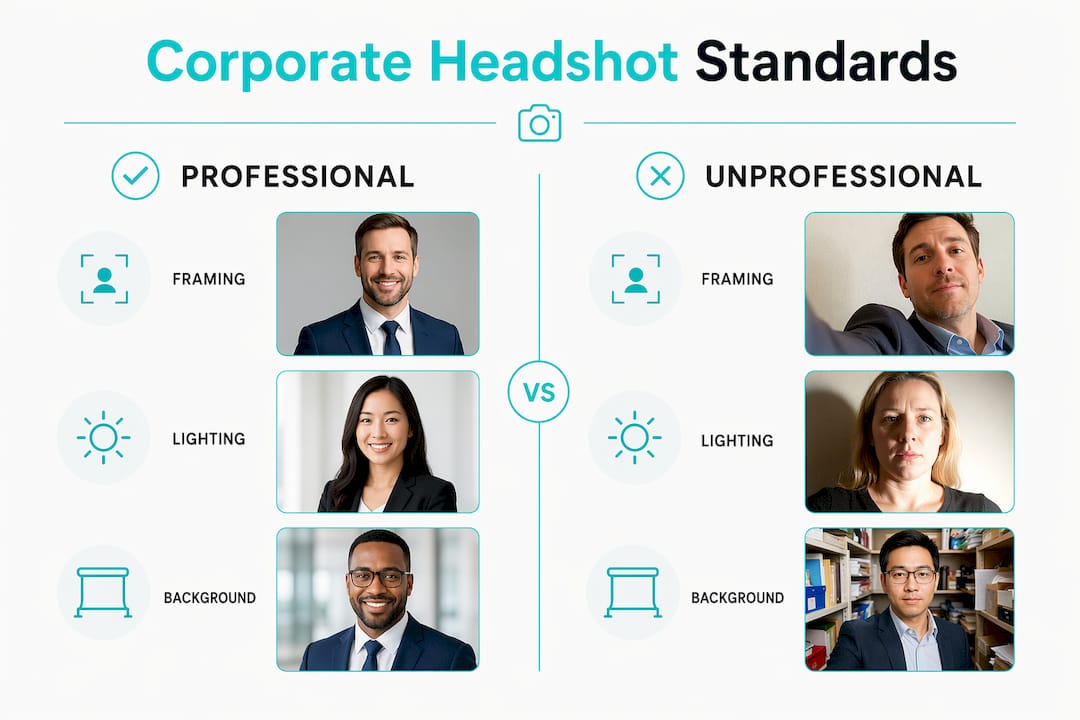
Six specific qualities separate a professional business portrait from a casual photo.
- Framing: The crop sits at the head and shoulders, tight enough to read clearly as a small thumbnail on LinkedIn or a company directory.
- Lighting: Soft, even light eliminates harsh shadows across the face. A two-light or three-light studio setup, or well-managed natural light, produces this result consistently.
- Expression: Confident and approachable. Not a forced smile, not a blank stare. The goal is an expression that says you are competent and easy to work with.
- Wardrobe: Simple, solid colors work best. Common wardrobe mistakes include busy prints, bold stripes, large logos, and heavy florals. These patterns distract the viewer’s eye away from your face.
- Background: Clean and neutral. A white, gray, or softly blurred background keeps the focus on you. Cluttered or overly stylized backgrounds belong in editorial work, not corporate profiles.
- File quality: Resolution matters. LinkedIn recommends at least 400×400 pixels, but uploading at 800×800 or higher preserves sharpness after the platform resizes and crops your image into a circle.
| Element | Corporate headshot standard | What to avoid |
|---|---|---|
| Framing | Head and shoulders, tight crop | Full body, wide environmental shots |
| Lighting | Soft, even, flattering | Harsh shadows, overhead fluorescent light |
| Expression | Confident, natural, approachable | Forced smile, blank or stern expression |
| Wardrobe | Solid colors, professional attire | Busy patterns, logos, casual clothing |
| Background | Neutral, clean, or softly blurred | Cluttered, colorful, or distracting settings |
| File size | 800×800 pixels or higher | Low-resolution phone screenshots |
Pro Tip: Before your session, check how your photo will appear in LinkedIn’s circular crop. Center your face and leave a small margin of headroom above your hair. Even a technically perfect photo looks awkward if the crop cuts off your forehead.
How does a corporate headshot differ from other portrait styles?
Corporate headshots and other portrait styles serve completely different purposes. Understanding that difference helps you choose the right type of photography for each professional need.
| Portrait type | Primary purpose | Typical setting | Composition focus |
|---|---|---|---|
| Corporate headshot | Business identity, trust, clarity | Studio or clean on-location | Tight head and shoulders |
| Editorial portrait | Storytelling, personality, mood | Environmental, contextual | Wider, includes surroundings |
| Casual portrait | Personal use, social media | Relaxed, informal | Variable, often candid |
| Executive lifestyle | Brand narrative, leadership presence | Office, boardroom, outdoor | Mid-body to environmental |
Corporate headshots prioritize consistency and clarity for business contexts. Editorial portraits emphasize mood, environment, and storytelling. That distinction is not just aesthetic. It reflects intent. A corporate headshot must communicate one clear message at a glance: this person is professional and trustworthy.
Editorial and lifestyle portraits work well for personal brand content, thought leadership articles, and speaking engagements where personality and context add value. For a LinkedIn profile photo, company bio, or press release, the corporate headshot format wins every time. Clarity beats creativity in those contexts.
The on-location corporate photography approach can blend the clean composition of a studio headshot with a relevant professional environment, giving executives a polished look that still feels grounded in their actual work setting.
How to prepare for a great professional corporate headshot session
Preparation determines the quality of your results more than any single piece of equipment.
- Choose your wardrobe in advance. Lay out two or three outfit options the night before. Solid colors photograph best. Navy, charcoal, white, and soft neutrals are reliable choices. Avoid anything with a large logo, a busy pattern, or a texture that photographs poorly, such as shiny fabrics.
- Groom intentionally. Schedule a haircut one week before the session, not the day before. Skin care matters too. Moisturize the night before to reduce shine and dryness under studio lighting.
- Communicate with your photographer. Share examples of headshots you admire before the session. Discuss the platforms where you plan to use the images. A photographer who understands your goals will direct your posing and expression more effectively.
- Arrive rested and on time. Fatigue shows in the eyes. A rushed start creates tension that the camera picks up immediately.
- Review the crop before you leave. Ask your photographer to show you how the image looks in a circular crop at thumbnail size. Positioning the face correctly prevents awkward cutoffs of the hairline or shoulders after platform resizing.
Professional headshots deliver superior authenticity and technical quality compared to DIY smartphone portraits or AI-generated images. Tools like HeadshotPro exist and are accessible, but they cannot replicate the nuanced lighting, directed expression, and professional editing that a skilled photographer provides. For serious career use, the difference is visible.
A headshot photography brief is a short document you prepare before your session that outlines your goals, preferred style, and intended platforms. Bringing one to your session saves time and produces better results.
Pro Tip: Ask your photographer for two or three final selects in different expressions, not just one. Recruiters and clients respond differently to subtle variations in warmth and directness. Having options lets you match the image to the context.
Key takeaways
A professional corporate headshot is the single most visible element of your personal brand, and its quality directly affects how others perceive your competence and trustworthiness.
| Point | Details |
|---|---|
| Definition and purpose | A corporate headshot is a head-and-shoulders portrait designed to signal trust and professionalism in business contexts. |
| Platform requirements | Upload at 800×800 pixels or higher on LinkedIn to preserve sharpness after circular cropping. |
| Six quality markers | Framing, lighting, expression, wardrobe, background, and file resolution define a professional result. |
| Corporate vs. editorial | Corporate headshots prioritize clarity and consistency; editorial portraits prioritize mood and storytelling. |
| Preparation drives results | Wardrobe selection, grooming, and clear communication with your photographer determine session quality. |
What I’ve learned about headshots after years behind the camera
The professionals who get the most value from their headshots are the ones who treat the session as a communication exercise, not a photo shoot. They come in knowing exactly what message they want to send. They have thought about their audience, their industry, and the platforms where the image will live.
The biggest shift I have seen in 2026 is the move away from stiff, overly lit studio images toward softer, more natural expressions. Modern corporate headshots favor genuine warmth over the blank authority look that dominated a decade ago. Recruiters and clients respond better to approachability. That does not mean casual. It means human.
I have also watched professionals try to cut corners with AI-generated headshots. The results are consistently unconvincing to anyone who looks closely. The lighting is technically correct but emotionally flat. The expression lacks the micro-variations that make a real face trustworthy. For a job application or a client pitch, that flatness costs you.
The professionals who invest in a real session with an experienced photographer, prepare their wardrobe, and communicate their goals clearly walk away with images they use for years. That is the return on investment that matters.
— Justin
Your next step toward a standout professional image
A well-executed corporate headshot session does more than produce a photo. It gives you a career asset you will use across every professional platform you touch.
At JFPhotos, we work with professionals and job seekers across Phoenix, AZ to create business portraits that are polished, authentic, and ready to use on LinkedIn, company websites, and press bios. Every session includes expert guidance on wardrobe, posing, and expression, plus professional editing and high-resolution files optimized for digital platforms. Whether you are updating your profile or building your personal brand from scratch, our Phoenix portrait photography team is ready to help. Visit JFPhotos to see our portfolio and book your session.
FAQ
What is a professional corporate headshot used for?
A professional corporate headshot is used on LinkedIn profiles, company websites, press bios, email signatures, and professional proposals. Its purpose is to introduce you visually and signal credibility before any direct interaction.
How is a corporate headshot different from a regular portrait?
A corporate headshot prioritizes clarity, consistency, and a tight head-and-shoulders crop for business use. A regular portrait may include environmental context, mood, and storytelling elements suited to personal or editorial use.
What size should a corporate headshot be for LinkedIn?
LinkedIn recommends a minimum of 400×400 pixels, but uploading at 800×800 pixels or higher preserves sharpness after the platform applies its circular crop and resizes the image in the feed.
Can I use a smartphone photo as my corporate headshot?
Smartphone portrait modes produce acceptable results in good light, but they cannot match the controlled lighting, directed expression, and professional editing of a studio session. For serious career use, a professional photographer produces a noticeably stronger result.
How often should I update my corporate headshot?
Update your headshot every two to three years, or sooner if your appearance changes significantly. An outdated photo creates a mismatch between your image and your in-person presence, which reduces the trust your headshot is designed to build.