
Share this article

How to Hire a Professional Product Photographer

Shortlist commercial photographers who show category-relevant samples, spell out licensing terms, and commit to a turnaround in writing. That single criterion eliminates most mismatches before a single email is sent. If you want a trusted local option right now, JFPhotos in Phoenix offers commercial and product photography with fast digital delivery and clear package terms. Before you sign anything, confirm three contract items: usage and licensing scope, exact deliverables with file specs, and revision or reshoot limits.


Table of Contents

What does a professional product photographer actually deliver?

Commercial photography covers more ground than most clients expect. A professional product photographer typically shoots packshots (clean, white-background images for product pages), hero images (styled, brand-forward shots for ads and homepages), lifestyle images (product in context), detail shots (texture, materials, close-ups), and 360-degree spins for high-consideration items. Infographic-style composites are common for supplement, beauty, and tech categories.

Standard deliverables vary by channel, but most studios deliver:

  • Web-optimized JPEGs (sRGB, 72–96 dpi, sized for Shopify, Amazon, or your CMS)
  • Print-ready TIFFs or high-res JPEGs (CMYK or sRGB, 300 dpi minimum)
  • Transparent PNGs for overlays, ads, and packaging mockups
  • Raw files (available from some studios on request, often at an added fee)
  • Retouched finals with dust removal, color correction, and background cleanup included

File Type Best Use When to Request
JPEG (sRGB) Ecommerce listings, social, email Always — baseline deliverable
TIFF / high-res JPEG Print catalogs, packaging, press kits Any print or large-format use
Transparent PNG Ad overlays, website banners Digital ads, web design
Raw files Internal archiving, future re-edits High-value SKUs, brand campaigns

For ecommerce, request sRGB JPEGs sized to platform specs. For a press kit or retail packaging, add print-ready TIFFs. A concise creative brief that lists shot types, platforms, and usage prevents most deliverable disputes before they start.


Who actually needs to hire a commercial photographer?

Not every product needs a professional shoot. Knowing when to invest and when to hold off saves real budget.

Hire a pro when:

  • You’re launching a new product line and first impressions drive conversion
  • Your listings appear on Amazon, Shopify, or wholesale portals where image quality directly affects click-through
  • You’re building a press kit or pitching retail buyers
  • Your product involves reflective surfaces, glass, jewelry, or textiles that require controlled lighting

DIY or stock imagery is acceptable when:

  • You’re testing demand with a prototype or limited-run item
  • You need internal mockups for team review, not public-facing assets
  • Volume is low and per-SKU lifetime value doesn’t justify the spend

The decision usually comes down to channel and stakes. A single hero image for a paid Facebook campaign can generate returns that dwarf its cost. An internal sample photo for a supplier conversation does not need that level of production.


How do you evaluate and choose the right photographer?

Treat this hire as a strategic business partnership — not just a creative transaction. The right photographer understands how images function across channels and can explain the strategic purpose behind each shot type.

Questions to ask before booking

  1. Do you have samples from my product category (beauty, food, apparel, tech)?
  2. What does your pricing include — retouching, file formats, revision rounds?
  3. What is your standard turnaround from shoot day to final files?
  4. How do you handle reshoots versus retouches — and what triggers each?
  5. What usage rights does the base fee cover (web, paid ads, print, resale)?
  6. Do you offer pre-production services or brief co-creation?
  7. What file formats and sizes do you deliver as standard?

Red flags to watch for

  • Portfolio shows only one style or category with no work similar to your products
  • Vague or verbal-only licensing (“you can use them however you want”)
  • No written timeline or delivery milestone in the proposal
  • Revision policy is undefined or unlimited, which often means disputes later

Contract essentials

Always get these in writing, per industry guidance: usage rights and licensing scope, file specifications and counts, revision tolerance (how many rounds, what counts as a revision vs. a reshoot), cancellation terms, and payment schedule. A contract that defines “reshoot” separately from “retouch” protects your budget from scope creep.


What does product photography typically cost?

Pricing models vary widely. Understanding the structure helps you compare quotes accurately.

Pricing Model Best For Typical Scenario
Per-image rate Small SKU counts, one-off launches 1–few products, precise budget control
Half-day / full-day rate Mid-size catalog shoots Several SKUs, studio time blocks
Project flat fee Defined campaigns with set deliverables Brand launches, press kits
Volume retainer Ongoing ecommerce content needs High-throughput catalogs, monthly refreshes

Cost drivers beyond the base rate include: SKU count, props and styling, model talent, surface complexity (reflective or transparent materials cost more in retouching time), licensing scope, rush fees, and travel. Retouching on reflective categories — beauty bottles, glass, polished metals — can take longer than the shoot itself, so build that into your timeline and budget estimates.

Statistic callout: For high-volume ecommerce catalogs, studios optimized for throughput deliver more per dollar than generalist photographers; for premium launches, art direction and production support justify the higher investment.

For a detailed look at what professional photography packages include at different price points, the JFPhotos investment page breaks down what’s covered at each level.


What does the production workflow look like?

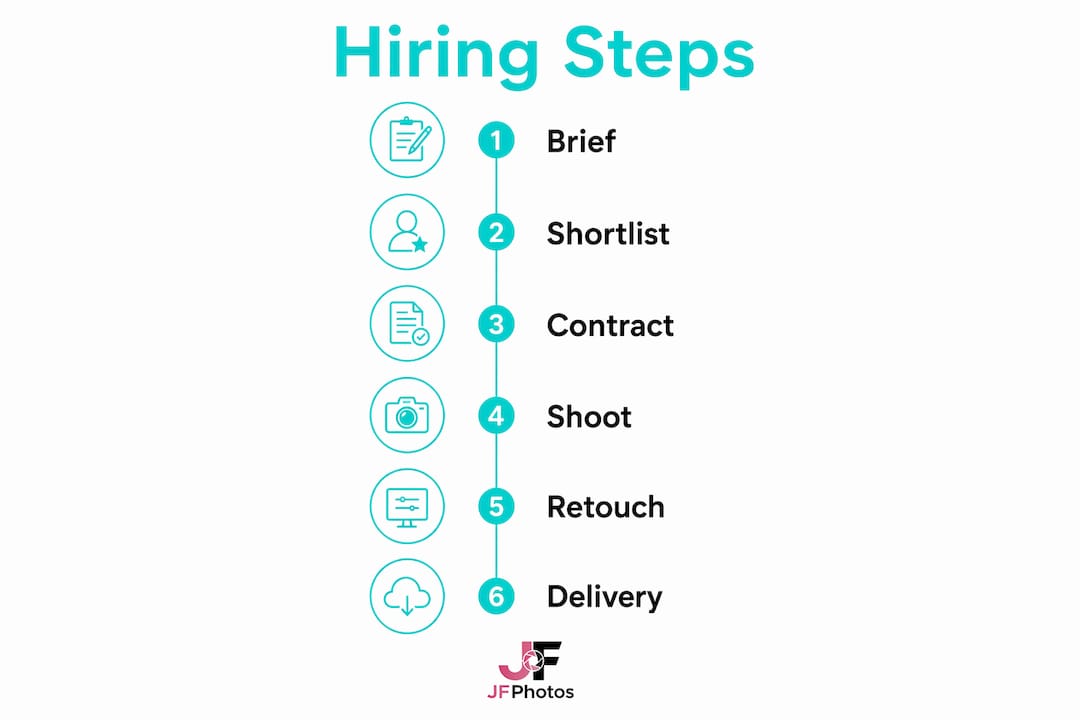
A typical shoot follows this sequence: brief → pre-production → capture → selection → retouch → delivery. Each stage has a client-side checkpoint.

Small shoot (4–6 images): Brief and approval take 1–2 days. Shoot day is typically under half a day. Retouching and proofing add 3–5 business days. Total: roughly one week from confirmed brief to final files.

Larger catalog (50+ SKUs): Pre-production planning runs 3–5 days. Shoot spans one to several days depending on complexity. Retouching scales with SKU count and surface type. Total: 2–4 weeks is realistic; plan for more on reflective or lifestyle-heavy catalogs.

Client-side delays most often happen at two points: sample shipping and approval chains. A 3–5 business-day shipping buffer before the shoot date lets the studio inspect inventory, flag damaged packaging, and confirm everything is ready. Slow internal approvals on proofs are the other common bottleneck — name your approver and set a review window in the brief.


How to prepare your products before the shoot

Good prep reduces reshoots, rush charges, and back-and-forth. Here’s what to do before you ship:

  • Send at least two units per SKU — one for capture, one as a backup. Fragile or high-handling items (jewelry, beauty) should include three or more units.
  • Clean every product — remove fingerprints, dust, and stray threads. Studios will prep further, but arriving clean saves time.
  • Label each variant clearly — color, size, and SKU code on the packaging or a tag attached to the item.
  • Include props and brand swatches if your brief calls for them — don’t assume the studio will source them.
  • Pack with tracking and insure high-value items. Ship with enough lead time to hit that 3–5 day buffer.

Pro Tip: A five-line brief — product type, platform, launch deadline, reference images, and approver name — is often enough for a studio to scope your project and return a quote the same day. You don’t need a polished document to start the conversation.


What should you look for in a portfolio and trust signals?

A strong portfolio shows category-relevant work, not just visually impressive images. Look for consistency across large sets, evidence of technical handling (glass, jewelry, textiles), and outputs formatted for multiple platforms (marketplace, social, print).

Trust signals that predict reliable delivery:

  • Case studies that mention outcomes (engagement lift, conversion improvement, sell-through rates)
  • Clear turnaround promises stated in writing, not just verbally
  • Transparent pricing or package examples on the website
  • Written contracts with licensing spelled out before any deposit is paid

“Your product photographer shouldn’t be someone who can just produce nice-looking imagery. They should understand how visual content supports business growth and know how to create assets that move customers from awareness to conversion.” — Jeremy Lee Photography

Ask for a short production case study during selection, not just a portfolio link. A photographer who can walk you through a past project — brief to delivery, including how they handled a challenge — tells you far more than a curated gallery. How photographer experience translates to measurable outcomes is worth understanding before you commit.


Key Takeaways

Hiring the right commercial photographer comes down to category fit, clear contracts, and a production process that keeps your timeline intact.

Point Details
Match category experience Request samples from your exact product type before shortlisting any photographer.
Lock down the contract Specify usage rights, file specs, revision rounds, and reshoot definitions in writing before paying a deposit.
Ship early with backups Send at least two units per SKU and allow a 3–5 business-day buffer for studio inspection.
Budget for retouching Reflective or glass products often cost more in post-production than in shoot time — factor this in.
JFPhotos for local shoots JFPhotos (Phoenix, AZ) offers commercial photography with fast digital delivery, clear licensing, and studio or on-location options.

Why experienced photographers deliver better business results

Photography that performs in a funnel looks different from photography that simply looks good. Engagement rates, click-through on ads, and conversion on product pages all respond to image quality, consistency, and how well the visual matches the buyer’s expectations at each stage. A photographer who understands those mechanics — not just lighting and composition — is the one worth hiring.

JFPhotos brings over a decade of commercial and portrait experience to every project. The approach starts with the brief: understanding the platform, the audience, and the launch timeline before a single light is set. That pre-production discipline is what keeps approvals fast and revisions minimal. For clients who need corporate headshots alongside product work, the same process applies — consistent quality, clear deliverables, and a turnaround you can plan around.


JFPhotos is ready when you are

JFPhotos offers commercial and product photography, event coverage, portrait sessions, wedding photography, and corporate headshots — all with fast digital delivery and licensing terms spelled out before the shoot. Studio and on-location options are available throughout Arizona and beyond.

Whether you’re preparing a product launch, refreshing your ecommerce listings, or booking a full brand shoot, the process starts with a one-page brief. Send your product type, platform, launch deadline, and any reference images, and JFPhotos will return a clear scope and price range quickly. When your images also need to shine on a well-built site, Coleman Web Design is a trusted partner for ecommerce presentation.

Contact JFPhotos to get your brief in front of a photographer who delivers on time and on brief.


Useful sources and next-step resources

  • How to Choose the Right Product Photographer — Jeremy Lee Photography: Covers the strategic framing of the hire, questions to ask, and how to evaluate whether a photographer’s work supports measurable brand outcomes.
  • 17 Questions to Ask Before You Book — Kasey Swan: A practical question list covering contracts, revision limits, reshoot definitions, and licensing — useful for any pre-booking call.
  • Product Photography Brief: What to Include — Pro Photo Studio: Explains what a collaborative brief should contain and how co-writing it with the studio reduces rework.
  • How to Prepare Your Products for a Photo Shoot — ProShot Media Group: Covers unit quantities, shipping buffers, and pre-shoot prep steps in practical detail.
  • How to Brief a Product Shoot — Photograph My Product: Explains how a short, focused brief aligns timelines and reduces costly revisions, with notes on reflective product retouching.

Recommended

Recent Posts

By Justin Frazier August 1, 2026
Discover the best deamorphotography.com alternatives for 2026. Explore trusted options like JFPhotos for your photography needs in Phoenix.
By Justin Frazier August 1, 2026
Discover the best deamorphotography.com alternatives for 2026. Explore trusted options like JFPhotos for your photography needs in Phoenix.
By Justin Frazier July 31, 2026
Discover what is documentary wedding photography and how it captures authentic moments, ensuring your special day feels as natural as it looks.
By Justin Frazier July 30, 2026
Master event photography lighting considerations with this essential guide. Learn tips to capture stunning images at any venue.
By Justin Frazier July 29, 2026
Discover effective wedding portrait lighting techniques to enhance your photos. Master backlight, off-camera flash, and continuous LEDs.
Family gathering outdoors with a woman kneeling to adjust a child’s hair as a man watches nearby.
By Justin Frazier July 26, 2026
Discover why families choose annual portrait sessions to capture growth, create memories, and build traditions. Relive your family's unique story.
Photographer taking a portrait of a woman by a colorful mural with a full-length mirror outdoors
By Justin Frazier July 25, 2026
Learn how to dress for professional headshots with expert tips on colors, styles, and necklines that enhance your image. Stand out!
Family reading a colorful brochure together outdoors in a sunny garden.
By Justin Frazier July 24, 2026
Discover what a family photography style guide is and how it ensures your family looks confident and comfortable in every photo session.
Text reading “Best hrphotoandfilm.com Alternatives for 2026” on a white background with pink abstract swirls.
By Justin Frazier July 23, 2026
Discover the best hrphotoandfilm.com alternatives for 2026. Explore top providers for local photography, technical services, and more!
Two people reviewing a photo album together at a kitchen table, smiling and pointing at pages
By Justin Frazier July 22, 2026
Discover why hiring a wedding photographer early is crucial. Secure your preferred date, find the right style, and enjoy peace of mind on your big day.
Show More